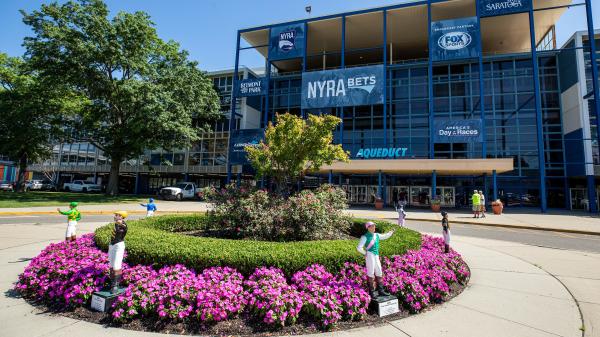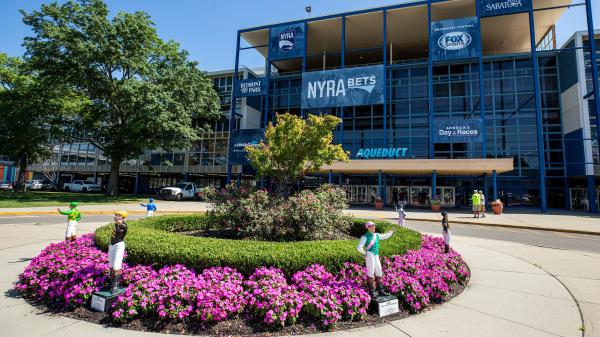
Aqueduct Racecourse has endured by means of the ups and downs of the New York Metropolis horse racing world since its early days in a nook of American horse racing. As soon as a so-called “outlaw,” the “Huge A” has hosted Triple Crown winners, legendary fights, and at the least one world chief. As we put together to say goodbye to this Gotham sports activities staple later this 12 months, observe this monitor’s evolution from diamond within the tough to shining gem.
unstable takeoff
“When it first opened, this monitor was solely six furlongs lengthy,” the outdated coach recalled. “And the Jockey Membership did not acknowledge it till it was a mile lengthy. It regarded like a stilt shack, and regardless of the grass, it was sort of like a boardwalk.”
James E. “Sonny Jim” Fitzsimmons, Corridor of Fame coach of two Triple Crown winners and plenty of different champions, was a part of a crowd of “roughly 700” on September 27, 1894, for the opening day of Aqueduct, an upstart racetrack constructed on 23 acres leased by the Queens County Jockey Membership from farmer Nicholas Ryder. Truck’s early infielder. It received its identify from its proximity to the aqueduct that brings water from Hempstead Plain to town’s Ridgewood Reservoir. Its founder was Thomas J. Riley, the son of a horse dealer and native politician. Francis J. Riley, Bronx Deputy Fireplace Chief. And Robert A. Tucker, a Brooklyn businessman who met the well-known Dwyer brothers of their youth, donated $50,000 to capitalize on town’s development increase and add its personal racetrack. The outdated grandstand might maintain about 2,000 folks, with spectators standing on the entrance garden on wood planks to maintain them from sinking within the mud, and the infield dotted with rows of still-growing crops.
The variety of racetracks in New York was growing, and on the time there have been 5 different racetracks working, however the brand new racetrack took on this new racetrack as a result of it lacked a license from the Jockey Membership. As a result of its racing oval was solely six furlongs, the Jockey Membership didn’t add Aqueduct to its official roster till its floor was over a mile lengthy. So these behind the racetrack leased extra land and renovated the monitor to carry it into compliance with Jockey Membership necessities. Regardless of its preliminary challenges, the upstart racetrack endured and grew in significance over the following decade, and after Thomas Riley’s demise in 1904, a number of members of the Jockey Membership bought Aqueduct, together with the well-known stablemate Philip Dwyer, who gained two Kentucky Derbies and 5 Belmont Stakes.
Below Dwyer’s administration, the Queens County Jockey Membership leased extra land, rebuilt the grandstand, and expanded the racetrack to 10 furlongs and 1,520 ft in size, making it one of many longest within the nation. Horse racing was standard within the New York space regardless of the rising energy of the anti-gambling foyer, however horse racing within the state continued for practically two years as Governor Charles Evans Hughes signed a sequence of anti-gambling payments. When the game returned to the Empire State, most of the racetracks that dotted the New York Metropolis space didn’t reopen, however Aqueduct endured and added a number of stakes races to Gravesend’s calendar, together with the Tremont Stakes for two-year-old horses, the Brooklyn Handicap, and the Brooklyn Derby (later renamed the Dwyer Stakes in honor of the brothers who performed essential roles within the horse racing scene) in its early years.
memorable moments
As racing returns to Ozone Park Racetrack, Suidobashi has change into the setting for a lot of legendary performances and its stakes calendar is a key a part of the game’s 12 months. Man O’ Struggle confronted John P. Greer within the 1920 Dwyer Stakes, and over 9 furlongs the 2 battled evenly, setting data at every pole. As the ultimate furlong approached, jockey Clarence Comer whipped Man O’ Struggle and the immortal icon surged forward of his depleted rival with a size and a half benefit. Will probably be the hardest take a look at for Huge Purple in his 20 profession wins.
The 1944 Carter Handicap was named after tugboat captain William Carter, who donated the purse and trophy to the primary occasion in 1895, and featured a triple useless warmth wherein Brownie, Bossuet and Wait-A-Bit hit the wire collectively, with the well-known photo-finish picture capturing the unlikely final result. That very same decade, John Cowdin, president of the Queens County Jockey Membership, led a renovation of town racetrack that shortened the oval distance from 10 furlongs to 1 mile. As the game continued to broaden throughout the continent, New York was coping with stagnation, so a revitalization effort was undertaken below the newly fashioned New York Horse Racing Affiliation. In 1959, the brand new aqueduct opened to a crowd of 42,473 folks, a far cry from the group that numbered within the lots of on the circuit’s opening day some 65 years earlier.
From 1963 to 1968, when Belmont Park underwent its personal redevelopment, Suidobashi, nicknamed “Huge A,” hosted the Belmont Stakes and a Triple Crown try (each unsuccessful) between Northern Dancer and Kauai King, in addition to Damascus’ dominant efficiency on the 1967 Belmont. The latter was owned by William Woodward’s daughter, Edith Woodward Bancroft, and was a white horse with pink polka dots from Bellaire Stud. Champions equivalent to Gallant Fox and Omaha had been educated by “Sonny Jim” Fitzsimmons. “Huge A” was the coach’s dwelling for many of his 70-year profession.
an emotional send-off
Within the many years since then, Aqueduct has hosted the second Breeders’ Cup (1985), the Pope’s Mass (1995), and has seen victories for most of the sport’s most well-known horses, together with Kelso, Dr. Fager, Cigar and Seattle Slew. Jockeys like Angel Cordero Jr., Steve Causen, and Jerry Bailey. and trainers Max Hirsch, Hirsch Jacobs and Allen Jerkens. Because the economics of horse racing have developed over the previous twenty years, it has change into tougher to keep up the New York space’s two racetracks, necessitating a brand new section and a farewell to the “Huge A.”
In 2026, the New York Horse Racing Affiliation will say goodbye to the newly rebuilt Belmont Park, say goodbye to the Aqueduct, and finish greater than a century of horse racing at Ozone Park. This second is a historic passing of the torch, persevering with New York’s custom as dwelling to the perfect that racing has to supply whereas embracing a brand new imaginative and prescient for racing in America, the birthplace of the game.