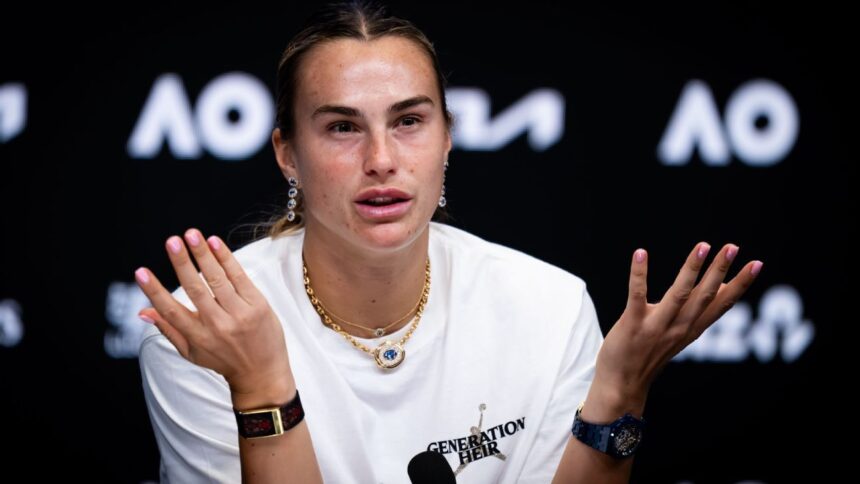
MELBOURNE, Australia — Wearable health trackers had been within the highlight at this 12 months’s Australian Open, with main gamers Carlos Alcaraz, Jannik Sinner and Aryna Sabalenka all requested to take away their gadgets in the course of the match.
The machine is extensively utilized in elite sport to gather physiological information that gives perception into well being and efficiency in coaching, competitors, restoration and sleep, and has been accepted to be used by the Worldwide Tennis Federation and the lads’s and girls’s excursions. However thus far, the 4 main tournaments, together with the Australian Open, French Open, US Open and Wimbledon, haven’t been accepted.
Nonetheless, Tennis Australia mentioned in a press release: “At present, using wearable gadgets just isn’t permitted at Grand Slam tournaments. The Australian Open is concerned in ongoing discussions about how this case may change,” and the state of affairs may change for future tournaments.
Sabalenka needs the ban to be lifted now. The highest ladies’s tennis participant, who’s aiming for her third Australian title in 4 years, mentioned after Tuesday’s quarter-final victory that the Australian Open and the opposite three main tournaments are out of step with the remainder of tennis.
Alcaraz and Sinner, who’ve shared the previous eight main males’s singles titles between them, had been requested by the referee throughout their fourth-round matches on Sunday and Monday to take away the straps they normally put on on their wrists.
Tennis Australia mentioned some wearable gadgets present athletes with indicators of inside load (measurements corresponding to coronary heart price), “which supplies gamers a 360-degree view of the work they’re doing and the way their our bodies are responding.”
Match organizers mentioned gamers on the Australian Open had entry to information that helped them monitor “key exterior load measurements” corresponding to distance traveled, modifications of course, excessive acceleration occasions, shot velocity and spin.
Know-how supplier WHOOP describes it as a “24/7 wearable coach designed that will help you enhance your well being, health, and longevity.”
The corporate mentioned in a social media put up that the know-how “boosts efficiency by design. That is the important thing.”
“Taking away that perception is like asking athletes to play blind.”
Sabalenka mentioned she obtained an e mail saying the tools had been accepted by the ITF, including: “I did not know Grand Slams hadn’t come to the identical conclusion.”
“I do not know why, as a result of we put on it in WTA tournaments and each match I play,” she mentioned. “I do not perceive why the Grand Slam tournaments will not enable us to put on them. I sincerely hope they rethink their determination and make the gamers comply with up with well being screens.”
Two-time Australian Open champion Sinner mentioned information collected from his wrist machine throughout matches will assist him get well and put together for future matches.
“There’s sure information that we wish to monitor a bit of bit on the courtroom. It isn’t uncooked,” he mentioned. “It is extra necessary to have the ability to see it after the sport. We additionally wish to use these information throughout observe classes, as a result of from there you’ll be able to observe with coronary heart price, energy burned, and every kind of different data.”
After his fourth-round victory over fellow Italian Luciano Daldelli, Sinner mentioned he shortly accepted the referee’s determination.
“I am fantastic. There are different issues I can use, like a vest, nevertheless it’s a bit of uncomfortable for me. It appears like I am carrying one thing on my shoulders. It is a bit of completely different,” he mentioned. “However guidelines are guidelines. I get it. I will not use it anymore.”
The Related Press contributed to this report.