MotoGP expertise director Corrado Cecchinelli mentioned the information confirmed the game’s new stability management system was working as designed.
Launched into the usual ECU halfway via final season, stability management (often known as slide management) is geared toward mitigating sure varieties of highsides.
Whereas that does not imply all interventions truly forestall collisions, Cecchinelli believes the system does cut back threat.
“The overall remark I could make is that producers are completely happy to have it,” Cecchinelli mentioned. crash internet.
“Everyone seems to be utilizing it and we have seen information that exhibits it really works, that means it is truly doing one thing quite than simply being ‘hidden’ in software program.
“However that additionally does not imply that with out stability management, a rider will certainly crash in a state of affairs the place stability management intervenes. It is unimaginable to know that.”
“So are we saving lives at this level? I do not know. I believe it is laborious to think about that it may very well be any much less protected than it was earlier than. I believe it is some distinction from zero when it comes to decreasing crashes, however we will not make issues worse.”
“Slides with out rotating”
MotoGP already had traction management, so why did it additionally want stability management?
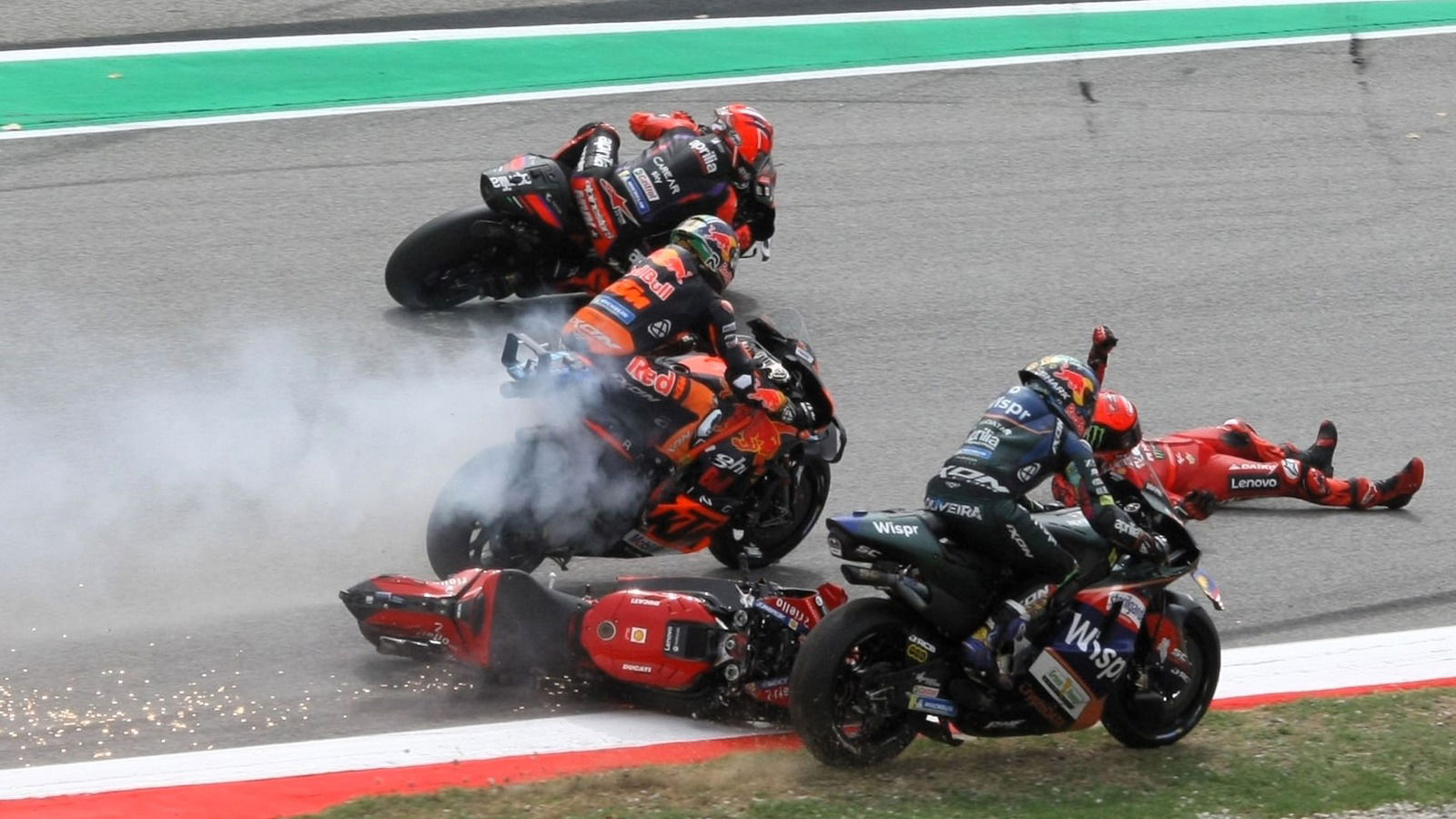
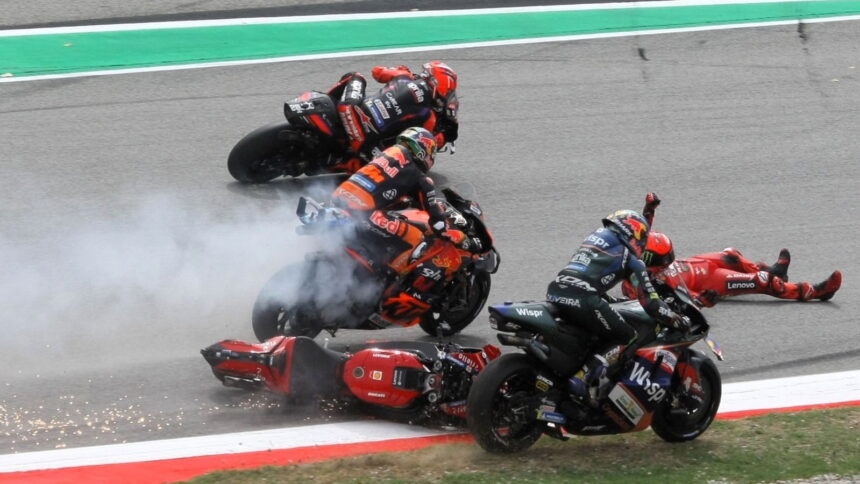
Stability management was developed to counter violent highsides just like the one skilled by Francesco Bagnaia at the beginning of the 2023 Barcelona spherical.
Italy’s Ducati was within the lead on the exit of the primary chicane when it abruptly snapped sideways and was thrown onto the observe (see video above; it was set to start out the second Bagnaia misplaced management).
He was tripped through the ensuing commotion, however fortunately escaped critical harm.
crash internet Cecchinelli requested him to explain a “textbook situation” the place stability management intervenes however traction management doesn’t.
“To start with, they’re engaged on totally different phenomena,” Cecchinelli started.
“Traction management controls rotation. Stability management, often known as slide management, controls slippage. So they’re two totally different phenomena, even though they typically happen on the similar time, however that is coincidental.”
“Sometimes, an excessive amount of spin causes a lack of traction, leading to slipping.
“However generally, Pecco’s notorious crash in Barcelona is an effective instance, we’ve seen circumstances the place a giant slide happens with no spin. And that is one thing you need to management utilizing stability management.”
“So, to reply your query, traction management, merely put, intervenes when it detects that the rear wheels are spinning too quick in comparison with the entrance wheels.
“What if the bike was doing a wheelie? In that case, you overlook the pace of the entrance wheel and use the assumed pace. However it is a element.
“The entire idea is to check the rotation of the rear tire to the pace of the bike. Nevertheless, the objective is rarely ‘zero spin’ because the tire can solely transfer ahead if there may be some spin.
“So there may be an optimum quantity of spin to speed up the bike, and an extra quantity of spin that you simply need to management.
“Each tire has a perfect quantity of spin to maximise acceleration, and this adjustments aggressively relying on a wide range of components akin to lean angle and temperature.
“And what everybody forgets is that the identical factor applies to braking. You want unfavorable wheelspin to provide most braking pressure. So if you happen to measure the revolutions of the wheel whereas braking, you may see that the wheel was ‘slower’ than the bike.
“So the goal spin is just not zero, and with traction management you may in precept at all times have a perfect spin proportion. It may very well be between 10 and 20 p.c. One thing like that.”

Brad Binder using his Crimson Bull KTM within the 2025 Portimao MotoGP.
“Excessive Snap”
Stability management is basically totally different and extra complicated.
“Stability management controls one thing known as yaw price, which is the angular price at which the bike rotates round its vertical axis. In different phrases, it isn’t how ‘sideways’ the bike is, however how rapidly the angle adjustments that issues.
“In different phrases, you want to management when the bike rapidly ‘snaps’ sideways.
“It is extra complicated than traction management, however you place the proper numbers into the system to your bike and it does precisely what it says it can do. It controls excessive snap in the identical approach traction management controls excessive spin.”
All digital management methods in the end demand one outcome. That is torque discount.
“All of those methods, together with wheelie management, merely ask the torque controller to scale back torque.
“Because of this methods akin to traction, stability, wheelie management, and so forth. are all mixed, and probably the most highly effective technique on the time takes priority, decreasing engine torque by a specified quantity.
“The top result’s at all times a discount in engine torque.”

2025 Indonesia MotoGP, Mandalika.
So, do they typically work on the similar time?
“Sure, however whatever the mixture of messages despatched by these controllers, there is just one output and that could be a discount in engine torque. Due to this fact, all of the controllers have to come back to a ‘consensus’ on what to do. That’s what is written into the software program,” Cecchinelli mentioned.
If a number of methods attempt to intervene on the similar time, probably the most requested torque minimize takes priority.
“Think about all three of us asking the system to scale back torque on the similar time. I ask for 10%, you ask for 20%, and the opposite particular person asks for 30%. They’ll win as a result of they need the most effective, so the system should cut back the torque by 30%.”
The strategy of torque discount is dependent upon the pace of the state of affairs.
Low-speed dynamics, akin to wheelies, are normally managed by electronically closing the throttle. Nevertheless, quicker occasions akin to sudden spins or snaps require ignition intervention.
“Sluggish motion is normally achieved by controlling the throttle. For instance, a wheelie is taken into account to be a sluggish phenomenon, so it’s primarily managed by closing the throttle,” says Cecchinelli.
“However fast dynamics like traction normally cannot be managed with the throttle. The throttle would not react quick sufficient. As an alternative, it reduces torque by decreasing the spark advance on some sparks to the purpose the place there is not any spark in any respect.”
“Retarding or slicing the ignition creates a ‘machine gun’ sound that may be heard alongside railroad tracks. This happens a whole bunch of occasions per second, so it’s the best approach to cut back engine torque.”
“Inside the official MotoGP ECU, groups can write of their desired sample of ignition minimize or retard for every situation.”
Stability management ‘most likely did not assist’ Maverick Vinales
Nevertheless, even a mixture of traction and stability management can not eradicate all highsides.
Riders can nonetheless lose the rear and be despatched highside by an off-throttle slide, as skilled by Tech3 KTM’s Maverick Vinales throughout moist qualifying on the Sachsenring final season.
Nevertheless, this accident occurred simply earlier than stability management was formally launched.
“The crash I had was as a result of I ran out of fuel, so the soundness management most likely did not do something,” Vinales admitted. Vinales suffered a shoulder harm that put the remainder of his season in jeopardy.
“This was a typical wet-weather, cold-tire crash, simply an off-gas excessive facet. So I do not assume (stability management) can forestall such a crash with out electronics.”
One other current instance of a pricey off-throttle highside was Aprilia’s Jorge Martin’s testing accident at Sepang 2025.