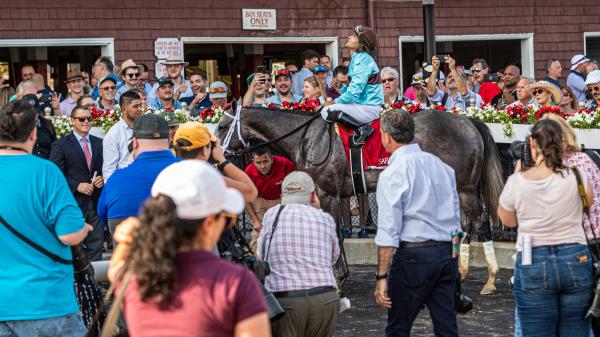
Racehorses similar to Suave, Tanya, Frisette, Jean Berreau and Burgomaster, in addition to historic venues similar to Saratoga Race Course and Belmont Park, carry the burden of historical past of their names.
William Collins Whitney continued a lineage of notable figures that started on this nation’s colonial days, together with women and men who imbued the household’s identify deeply in society in addition to the nation’s navy and economic system. Though his racing profession was brief in comparison with his predecessors, Whitney’s racing legacy contains these names and plenty of extra, with Eton blue and brown silks as the inspiration of the game a well-recognized sight in each winner’s circle.
household basis
The Whitney household’s American roots date again to the seventeenth century.th century when John and Eleanor Whitney emigrated from London to Watertown, Massachusetts, the place they settled and began a household that might come to dominate the game of horse racing.
William Collins Whitney was born nearly two centuries later, the second of 4 kids to businessman and politician James Scoley Whitney and Laurinda Collins, whose household was a part of the founding authorities of Plymouth Colony. William accomplished his training at Yale College, then studied legislation at Harvard College, and was admitted to the New York bar in 1865.
He married Flora Payne in 1869 and together with her they began a household of 5 kids. These included his eldest son, Harry Payne, and his second son, William Payne, each of whose names shall be acquainted to anybody who is aware of the historical past of horse racing. Nevertheless, William Collins Whitney’s personal involvement within the sport must wait, as he had different roles to fill earlier than his position as breeder and proprietor was fulfilled.
Like his father James, William additionally turned politically energetic, first as a New York Metropolis faculty trustee and later as town’s company counsel, managing its authorized affairs. He served as Secretary of the Navy throughout President Grover Cleveland’s first administration (1885-1889) and spearheaded upgrades to the nation’s fleet, together with metal steamships and trendy naval weapons.
On the finish of his time in Washington, Whitney turned a accomplice in founding the New York Mortgage Enchancment Firm in 1890, creating town’s Washington Heights neighborhood. He additionally participated in Cleveland’s marketing campaign for his second time period as president, and along with his brother Henry Melville Whitney helped set up the Dominion Coal Firm and Dominion Metal Firm, which might later be offered to James Ross, father of Commander James Kenneth Leveson Ross, who raced America’s first Triple Crown winner, Sir Burton.
Together with his enterprise and political dealings settled, William Collins Whitney turned to horse racing, a standard sporting exercise for males of his time.
The very best factor cash should purchase
within the final decade of 1919th On the flip of the century, Whitney, like friends like James R. Keene, John E. Madden, and August Belmont II, turned to utilizing his wealth to breed and personal the best thoroughbreds. His involvement within the sport was short-lived, but it surely was sufficient to depart a big impact.
He started his journey into horse racing by changing into a founding member of the Jockey Membership, which was based in 1894 together with Belmont, Keene and 20 others. Whitney registered Silk with a brown cap on Eaton Blue and commenced a shopping for spree, buying as much as $1 million price of horses by the point he completed. He additionally constructed stables for as much as 84 horses and a one-mile coaching monitor on his Westbury property in Nassau County, and employed Sidney Padgett, brother of Whitney’s son-in-law Almeric Hugh Padgett, as racing director.
To start his horse racing profession, he bought ten horses and commenced racing them beneath the identify Paget. Whitney additionally employed Sam Hildreth as a coach in 1898. The son of an itinerant horse coach who raced primarily within the Midwest, Hildreth grew up round thoroughbreds and horses, and frolicked as a blacksmith earlier than turning to proudly owning and coaching horses. His begin within the East was not in New York, as his inventory was less than the standard of that circuit, however in New Jersey, the place he was racing on the state’s Outlaw monitor. His success caught the eye of Whitney, who introduced him into coaching on the nascent Westbury Stables, together with his first massive buy, the stallion Jean Bellow.
The stallion, named after the French artist, was the primary horse to win $100,000 out of undefeated sensation Carrie C, and was created by His Royal Highness. The horse was bred and owned by John Daly and was already a stakes winner when Padgett purchased him for $40,000 in the summertime of his two-year-old season.
In 1899, Jean Belau added the Belmont and Wizards Stakes at age 3, adopted by the Brookdale Handicap at age 4. Throughout these early years, Whitney additionally acquired the Duke of Magenta’s widespread steeplechase Cirella. This gelding fell throughout a race and sadly needed to be euthanized. Saratoga officers would later identify a steeplechase race for Whitney’s dropping racer.
Regardless of getting into the game late in life, Whitney wasted no time in increasing his investments past a number of horses in New York. He additionally despatched potential expertise to England with the purpose of profitable the derby at Epsom. To that finish, he leased the stakes winner Volodyyovsky from Girl Moo, and received the 1901 Derby with a colt, changing into solely the second American to take action, after Pierre Lorillard had executed so with Iroquois 20 years earlier. Whitney would strive once more the next yr with Intruder, a son of Medlar produced in Lovellstad, Kentucky.
In his 1902 privately revealed ebook Whitney Stud, the previous Secretary of the Navy shared particulars in regards to the stallions he had amassed, together with a herd of mares and stallions Hamburg and Medlar. A Corridor of Fame horse and main sire, Hamburg was the most costly foal in historical past when John E. Madden offered him in 1897 to mining magnate Marcus Daly for $40,001. Daly died in 1900, and Whitney bought the stallion at a steady sale for $60,000. He additionally bought the imported horse Medlar for $49,000, and among the many foals he produced for Blue and Brown was Tanya, his second filly to win the milestone Belmont Stakes, which occurred one yr after Whitney’s loss of life in 1904.
Except for his stakes winners and stallions, his most essential contribution to the game could be the conventional upstate racetracks which have develop into synonymous with the Whitney of all time.
The Spa Resurgent
When Saratoga Race Course opened in 1863, its patrons included John Morrissey, William Travers, and Leonard Jerome, however by 1891 Morrissey was gone, and competitors from many different racetracks left Spa in need of horses and bettors. Gottfried Walbaum, the person behind New Jersey’s notorious Guttenberg Race Course, purchased 90% of the racetrack’s inventory that yr, and from there, the previous playground of a technology of rich house owners gained notoriety. Affected by its collapse, Whitney, Richard T. Wilson, Andrew Miller and others pooled their cash collectively to buy Saratoga Race Course with the aim of restoring it to its glory.
Over the subsequent few years, Spa’s new administration improved the racetrack, invested in its future, and tied Whitney’s identify and fame to the whole lot as president. When his buddy August Belmont II needed to construct a brand new racetrack within the New York space, Whitney was one of many buyers who helped create Belmont Park, one other enterprise that demonstrated his dedication to horse racing.
Though his curiosity within the sport was just a few years outdated, his investments have been important, encompassing pedigree, services and extra. That included his sons Harry Payne and William Payne Whitney, who each inherited the bug and planted their very own seeds within the sport.
A ruptured appendix and subsequent an infection introduced the patriarch’s tenure in racing to an abrupt finish in 1904. A person of many levels, William Collins Whitney went from Ivy League-educated lawyer to political chief to businessman to horse protector, establishing a legend in his Eaton blues and browns that lasted into the twenty first century.cent century.