Ducati ushered within the trendy aerodynamic period in MotoGP when the Desmosedici grew winglets throughout pre-season testing in 2015.
The Bologna manufacturing unit then continued to topic rivals to aerodynamic ‘soiled air’ for the higher a part of the following decade as improvement accelerated throughout the grid.
However whereas Ducati’s idea was broadly imitated, Aprilia emerged as a key innovator, most notably with the introduction of ground-effect fairings in 2022.
At present, homologation rules limit updates to the entrance fairing, so the small print are cut up between producers.
Rear aero, alternatively, stays limitless and has grow to be a form of battleground, with many groups providing a number of configurations to swimsuit rider alternative and circuit traits.
Aprilia was as soon as once more within the lead, putting a seat-mounted wing behind the rider’s legs. That is an space outdoors of present homologation restrictions.
Honda, KTM, and from the latest COTA spherical Ducati even have “leg wings” obtainable.
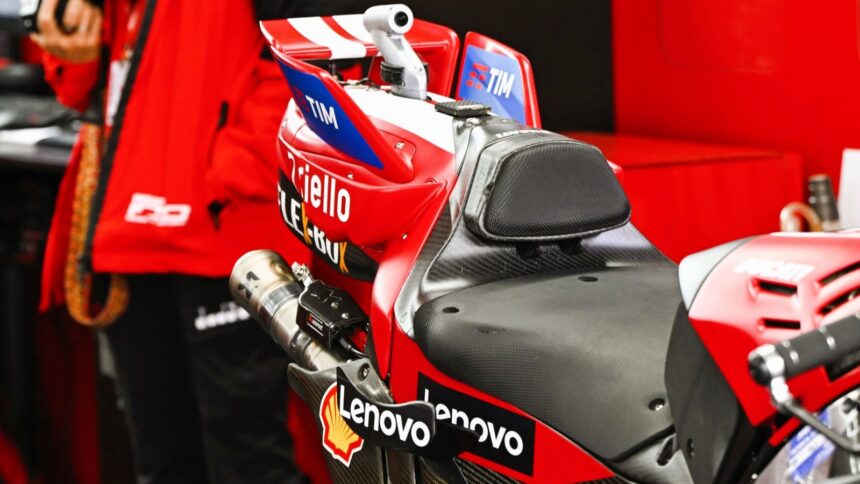
Ducati’s model debuted with a modest measurement in comparison with Aprilia and an improved rear wing just like present designs from Aprilia, KTM and Yamaha.
These seem to mix the vertical facet vanes of a ‘Stegosaurus’ aero with the downforce advantages of a standard ‘F1 fashion’ wing profile.
Honda has experimented with rear wings previously, however presently solely makes use of vanes.

Marc Marquez, new rear aero, 2026 US MotoGP.
© Gold & Goose

Aprilia rear aero and leg wing, MotoGP 2026.
© Gold & Goose

KTM Rear Aero and Leg Wing, MotoGP 2026.
© Gold & Goose

Yamaha Rear Aero, 2026 US MotoGP.
© Gold & Goose

Honda rear aero, 2026 US MotoGP.
© Gold & Goose
“Improved stability in high-speed corners”
Requested if Aprilia was the inspiration for the newest aero, Ducati group supervisor Davide Tardozzi advised MotoGP pitlane reporter Jack Appleyard:
“Clearly you at all times must keep watch over who’s within the lead, and Aprilia appears to be performing very effectively at this second, so why not have a look…”
Ducati’s aerodynamics gave the impression to be working, and manufacturing unit riders Marc Marquez and Pecco Bagnaia maintained it for the remainder of the US MotoGP weekend.
“I really feel like I’ve extra stability in high-speed corners,” Bagnaia defined. “Getting out of high-speed corners is now extra snug.”
Bagnaia then got here inside half a lap of profitable the COTA dash, however was overtaken by Aprilia’s Jorge Martin, who was using on medium rear tires.
All riders then used mediums for the Grand Prix, however Bagnaia once more suffered a serious tire drop, dropping him from fifth to tenth.
Marquez fought again from a protracted lap penalty to maneuver as much as fifth place.

Fabio Di Giannantonio, 2026 US MotoGP.
© Gold & Goose
Nonetheless, VR46’s Fabio Di Giannantonio completed 4th as the highest Ducati rider with out the brand new aero.

Marco Bezzecchi’s broken rear aero, 2026 US MotoGP.
© Gold & Goose
Seven seconds forward of Di Giannantonio, Aprilia title chief Marco Bezzecchi took his fifth consecutive Grand Prix victory regardless of injury to the rear of his RS-GP, with Martin second.
Aprilia Racing CEO Massimo Rivola recognized the place the wing could be only when discussing injury.
“Marco’s tempo was penalized by the dearth of a rear wing, particularly below arduous braking, however there’s loads of that right here.
“The rear of the bike was clearly lighter, extra unstable and subsequently harder to manage.
“He is carried out a terrific job adapting…If others suppose aerodynamics does not matter, allow them to suppose so.”