
F1 groups have unanimously agreed to enhance the much-derided 2026 laws.
The rule adjustments had been confirmed on Monday, April 20, following a key digital assembly involving governing physique the FIA, workforce principals, energy unit producer chief executives and F1 administration.
The ultimate proposal was submitted at a crunch assembly on Monday and, topic to passing an digital vote by the FIA World Motor Sport Council (WMSC), was accredited for the 2026 F1 season to happen from the subsequent race of the season, the Miami Grand Prix, on Could 3.
What F1 guidelines have been adjusted?
There are two changes, three associated to qualifying and three associated to the race itself.
The primary situation change will cut back the allowable cost charge from 8MJ to 7MJ to scale back the necessity for overharvesting and encourage extra flat-out operation. The FIA stated the adjustments “purpose to scale back the utmost period of the superclip to roughly 2-4 seconds per lap”.
Second, the SuperClip’s peak energy output has been elevated from 250kW to 350kW. This additional reduces charging instances and reduces the motive force’s burden in vitality administration. This adjustment additionally applies to race situations.
The ultimate qualifying adjustments have revised the variety of occasions for which different vitality flooring limits could apply. The variety of races has been elevated from 8 to 12 races, permitting for extra flexibility in adapting to the traits of the circuit.
For the Grand Prix itself, the utmost energy out there by increase in race situations is proscribed to 150kW. That is supposed to scale back dramatic efficiency variations.
The MGU-Ok deployment is maintained at 350kW from the west of the nook to the braking level, together with the overtaking zone, however is proscribed to 250kW for the remainder of the lap.
These adjustments are designed to deal with considerations about dramatic ending velocity variations that got here to the fore following Olly Bearman’s horrific 50G crash on the final Japanese Grand Prix.
How will the race begin?
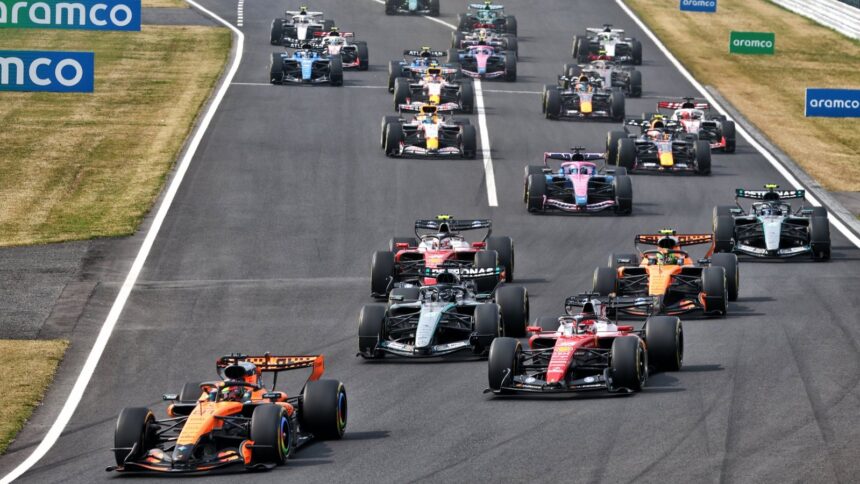
One other key space the place security considerations have been raised in relation to race begins, however Ferrari has decisively thwarted earlier makes an attempt to vary the beginning process.
The FIA confirmed that enhanced security mechanisms might be examined in Miami and adopted following additional suggestions and evaluation.
These embrace a brand new “low energy begin detection” system developed to determine automobiles which have “abnormally low acceleration” instantly after the motive force releases the clutch.
In such circumstances, computerized MGU-Ok deployment is triggered with the intention to “guarantee a minimal acceleration degree and cut back start-related dangers with out introducing any sporting benefit.”
That is carried out together with a brand new visible warning system that alerts drivers with flashing lights on the rear and sides of affected vehicles.
Moreover, an vitality counter reset was applied firstly of the formation lap to appropriate beforehand recognized system discrepancies.
Press for elevated security in moist situations
Following suggestions from drivers, ideas had been additionally submitted to enhance security and visibility in moist situations.
The tire blanket temperature of the intermediate tire is elevated to enhance preliminary grip and tire efficiency within the moist, whereas most ERS growth is diminished to restrict torque and enhance automobile management in low grip situations.
The rear gentle system has been simplified with clearer and extra constant visible cues, bettering each visibility and response time for drivers behind you, particularly in poor situations.